Lauri Aalto visited us from Finland via Aquaba. He had to finish the water part of the 2 star AIDA course and went on to do the water part of the 3 star course. On the first day it became apparent that there was an equalisation issue. His Frenzel was nearly correct, but the nearly was creating a problem.
There was no movement in the area of the diaphragm, therefore no hybrid of Frenzel and Valsalva. The little pits behind the nostrils were inflating correctly with each equalisation and the muscles under the chin and lower jaw were also contracting correctly, but still each equalisation was too forced and too slow.
His problem was easily noticeable when he equalised with his mouth wide open in front of the mirror. The front of his tongue was pushing forcibly against his bottom teeth. This is a common fault and is usually the result of miss-understanding or in correct teaching, the student believes that in order to raise the back of the tongue he must push the front of the tongue against the bottom teeth. This vastly complicates the issue making the equalisation too slow and bringing in a lot of tension, which means problems at depth!
After the first day Lauri did 3 hours of dry practice and arrived the next day with the problem solved. He could equalise with the mouth wide open and only the back of the tongue was active pushing against the soft palate.
Lauri came with an excellent water sense ,great determination combined with good humour and intelligence, so his progress was astonishing. A small amount of polishing on the duck dive was necessary, after that concentration could be brought to tactics – correct weighting, counting strokes for determining when to go into the glide, and correct technique for the glide.
His partner work was exemplary.
Altogether Lauri was a joy to work with we had very rough seas and 20 knot winds and on the last day one of the worst currents I have seen in recent years. In spite Lauri completed his 30 mt dive with ease. He is to be congratulated on achieving all his objectives, a very creditable performance.

 This video is the first to come after a long silence period. I have recorded it after a week of none diving, and only doing dry training and conditioning at home, and trying to answer your questions. It ended up being a rant, and not practically about Coronavirus, but I hope you’ll enjoy and understand. I definitely will attempt to record a video about training in these days of lockdown.
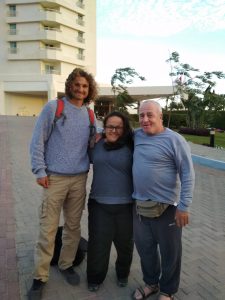 Writing has always been a challenge for me and inevitably gets postpone until it becomes irrelevant. However, two weeks ago Harry Chamas did me the great honour of coming up from Dahab to meet me. I was already predisposed to like Harry, from his writings, and from what Alina told me about him from her visit in Dahab last March. And from what I knew of his history as a Royal Marine, and also from his youtube channel.

 Okay, this is an update from freedivers. This, for me, is an absolutely golden
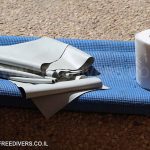 This is an excellent exercise for training FIM (Free Immersion). The one shown, is for very advanced divers. However this can easily be adapted to your specific objectives.
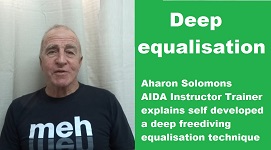

 The 6th day of training for my 2 Giants – Walter Chivescu and Jeroen Van Haudt. We had been doing a lot of empty lung training, to acclimatize to pressure. Learn my advanced technique of equalisation for depth, and get used to the noseclip. Yesterday the sea was perfect, 20mt visibility, no current and the surface like glass. The white line, a thread, an invitation into the deep blue, there were smiles exchanged, I felt a surge of joy and knew it would be a good day. Things began slowly, each wrestling with
 Â Well I just had to! 🙂
 Well I just had to! 🙂